


Welcome to our Nutty History hub, where the past is anything but dry and the stories are as rich and flavourful as our delicious almonds.
Here, we crack open the fascinating origins, quirky legends, and surprising cultural moments that have shaped the nutty world through the ages.
Cracking open
historical insights!
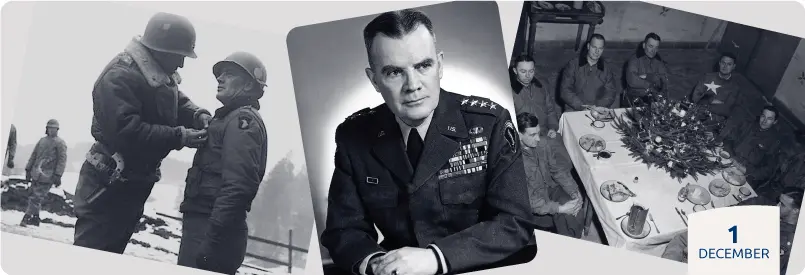

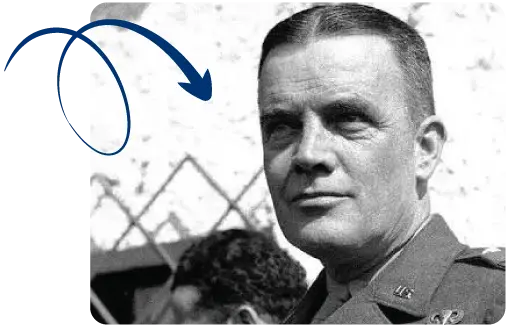
General Anthony Clement ‘Nuts’ McAuliffe (2 July 1898 – 10 August 1975) was a senior United States Army officer who earned fame as the acting commander of the 101st Airborne Division defending Bastogne, Belgium, during the Battle of the Bulge in World War II. He is celebrated for his one-word reply to a German surrender ultimatum: "Nuts!"
Brigadier General McAuliffe commanded the division artillery of the 101st Airborne Division when he parachuted into Normandy on D-Day. He also landed by glider in the Netherlands during Operation Market Garden.
Christmas 1944
In December 1944, the German army launched the surprise attack that became the Battle of the Bulge. Major General Maxwell D. Taylor, commander of the 101st Airborne Division, was attending a staff conference in the United States at the time. During Taylor's absence, McAuliffe commanded the 101st and its attached troops. At Bastogne, the 101st was besieged by a far larger force of Germans under the command of General Heinrich Freiherr von Lüttwitz.
The German ultimatum
On 22 December 1944, General von Lüttwitz dispatched a party, consisting of a major, a lieutenant, and two enlisted men under a flag of truce to deliver an ultimatum.
Entering the American lines southeast of Bastogne (occupied by Company F, 2nd Battalion, 327th Glider Infantry), the German party delivered the following to Gen. McAuliffe:
To the U.S.A. Commander of the encircled town of Bastogne.
The fortune of war is changing. This time the U.S.A. forces in and near Bastogne have been encircled by strong German armoured units. More German armoured units have crossed the river Ourthe near Ortheuville, have taken Marche and reached St. Hubert by passing through Hompre-Sibret-Tillet. Libramont is in German hands.
There is only one possibility to save the encircled U.S.A. troops from total annihilation: that is the honourable surrender of the encircled town. In order to think it over a term of two hours will be granted beginning with the presentation of this note.
If this proposal should be rejected one German Artillery Corps and six heavy A. A. Battalions are ready to annihilate the U.S.A. troops in and near Bastogne. The order for firing will be given immediately after this two hours term.
All the serious civilian losses caused by this artillery fire would not correspond with the well-known American humanity.
The German Commander.
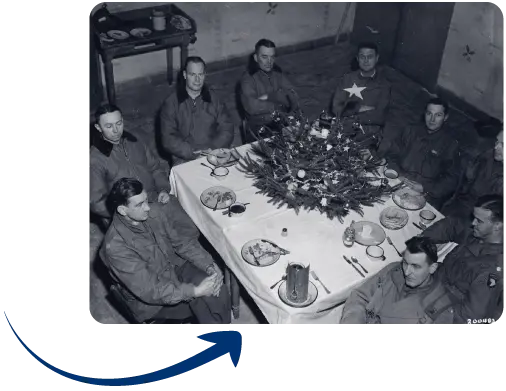
Brigadier General Anthony McAuliffe and his staff gathered inside Bastogne's Heintz Barracks for Christmas dinner 25 December 1944. This military barracks served as the Division Main Command Post during the siege.
The reaction
According to those present when McAuliffe received the German message, he read it, crumpled it into a ball, threw it in a wastepaper basket, and muttered, "Aw, nuts".
The officers in McAuliffe's command post were trying to find suitable language for an official reply when Lieutenant Colonel Harry Kinnard suggested that McAuliffe's first response summed up the situation well, and the others agreed. The official reply was typed and delivered by Colonel Joseph Harper, commanding the 327th Glider Infantry, to the German delegation. It was as follows:
To the German Commander.
NUTS!
The American Commander.The German major appeared confused and asked Harper what the message meant. Harper said, "In plain English? Go to hell." The choice of "Nuts!" rather than something earthier was typical for McAuliffe.
Captain Vincent Vicari, his personal aide at the time, recalled that "General Mac was the only general I ever knew who did not use profane language. 'Nuts' was part of his normal vocabulary."
The artillery fire did not materialize, although several infantry and tank assaults were directed at the positions of the 327th Glider Infantry. In addition, the German Luftwaffe attacked the town, bombing it nightly. The 101st held off the Germans until the 4th Armoured Division arrived on 26 December to provide reinforcement.
Post-Bastogne
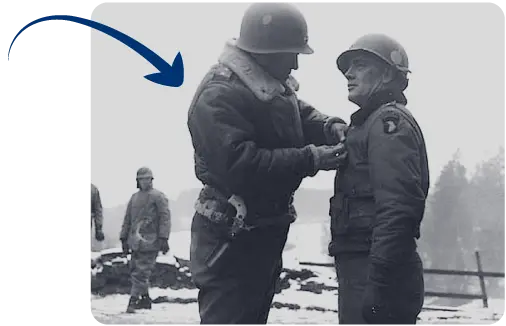
For his actions at Bastogne, McAuliffe was awarded the Distinguished Service Cross by Lieutenant General George S. Patton, commanding the Third Army, on 30 December 1944 with official orders processed on 14 January 1945. He later received the Army Distinguished Service Medal twice, the Silver Star and the Legion of Merit.
Brigadier General Anthony McAuliffe is decorated by Patton with the Distinguished Service Cross for the defence of Bastogne.
Sources:
https://en.wikipedia.org
https://www.army.mil › article
https://archivesfoundation.org